Digital Technologies – Interactive Learning Solutions for Higher Education
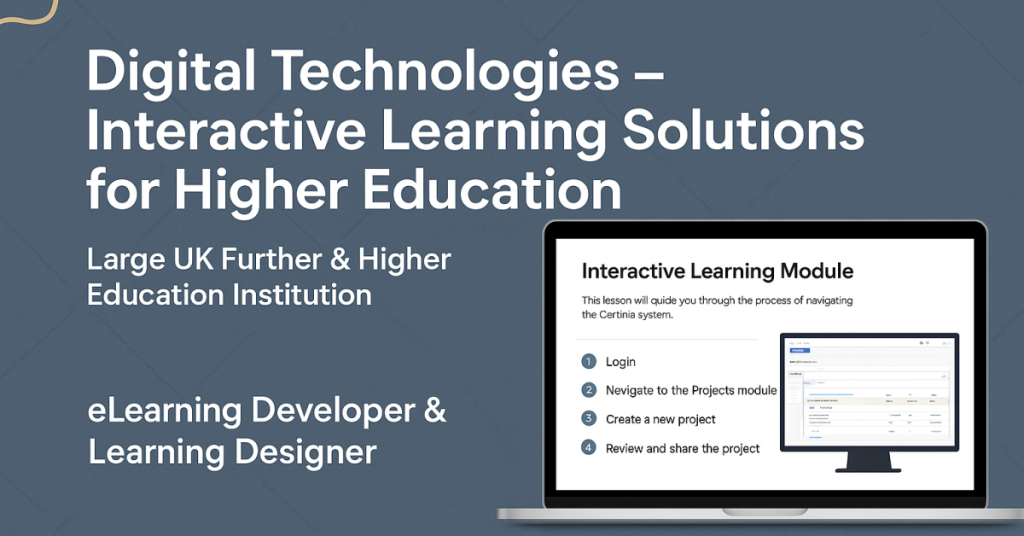
Client: Large UK Further & Higher Education Institution
Duration: November 2024 – March 2025
Role: eLearning Developer & Learning Designer
Tools Used: Articulate Storyline 360, SCORM, LMS Integration
Overview
A leading educational organisation sought to enhance its Higher National Certificate (HNC) in Digital Technologies programme. The goal was to design and develop interactive SCORM-compliant modules that boosted student engagement, ensured accessibility, and delivered measurable learning impact.
As part of this project, I collaborated with project managers, stakeholders, and other learning designers to create accessible, interactive solutions that made complex subjects — such as Big Data, Cloud Networking, Security, and Data Analytics — digestible, engaging, and inclusive.
Objectives
- Collaborate with stakeholders and project managers to ensure high-quality outputs.
- Develop 20 SCORM-based interactive modules tailored to the HNC Digital Technologies curriculum.
- Ensure all learning met accessibility standards, providing equitable experiences for every learner.
- Meet tight project deadlines while maintaining quality and instructional design best practice.
- Implement robust quality assurance (QA) and sign-off processes for every deliverable.
Key Deliverables
- ✅ 20 interactive SCORM modules, fully QA’d and signed off
- ✅ Learning design aligned to real-world applications in digital technologies
- ✅ Seamless integration into the institution’s LMS
- ✅ Clear, documented handover of resources for ongoing use
- ✅ Accessibility built into every module as a non-negotiable standard
Results & Impact
- Enhanced student learning experience through interactive design and engaging content.
- Increased knowledge retention for challenging digital technology subjects.
- Positive feedback from stakeholders, project managers, and students.
- On-time delivery despite tight project timelines.
- Set a benchmark for future digital learning initiatives within the organisation.
Behind the Scenes
- Accessibility by design: Every module adhered to accessibility standards, ensuring inclusivity.
- Collaboration & trust: Returning to a familiar organisation meant smoother onboarding and immediate productivity.
- Remote teamwork: Effective coordination across designers, developers, QA, and stakeholders ensured quality and consistency.
- Documentation & legacy: A meticulous handover process ensured resources were logically stored, documented, and future-proof.This project reinforced my belief that training success goes beyond launch. Measuring impact, gathering feedback, and continuously refining materials were key to ensuring users didn’t just complete training — they thrived with the new system.
This project reinforced my commitment to learner-first design. By breaking complex content into digestible, interactive modules, we ensured engagement, inclusivity, and measurable impact. It also highlighted the importance of collaboration, quality assurance, and accessibility as core pillars of eLearning development.
“Accessibility isn’t just a requirement; it’s a foundation of effective, equitable learning.”